Search and AI visibility
How to rank in ChatGPT and other AI assistants: a small business guide
Ranking in ChatGPT means your business is named or cited when it answers a customer's question, because there is no numbered list to climb. To get there, let the right crawlers in, get indexed in Google and Bing, answer customer questions in your first lines, keep business facts identical everywhere, earn honest reviews and mentions, and test every month.
Key takeaways
- ChatGPT has no position one. You are either named, cited with a link, or missing, and the answer can change from one day to the next.
- OpenAI says sites that block its OAI-SearchBot crawler won't appear in ChatGPT search answers, apart from navigational links, and robots.txt changes take about 24 hours to reach its systems.
- Google says its AI Overviews and AI Mode need no special optimization: a page must be indexed and eligible to show with a snippet.
- Clear answers, matching business facts and honest mentions get you cited; an llms.txt file, bought reviews and keyword stuffing have no effect.
- Flamcom's SEO retainer, from $1,499 a month, tests six AI engines monthly and reports each one on its own line.
What does it mean to rank in ChatGPT?
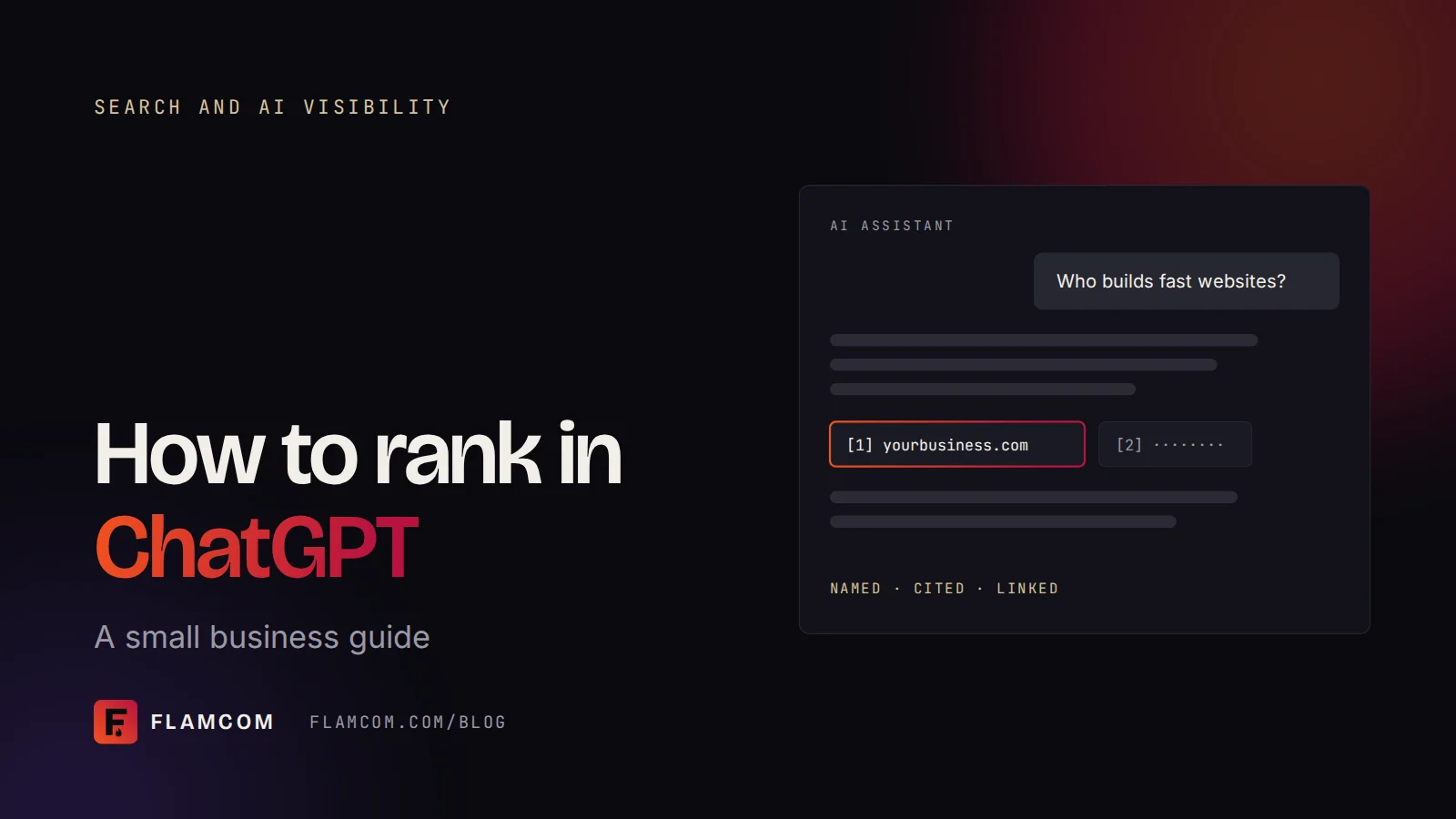
It means ChatGPT mentions your business by name, links to your site as a source, or both, when someone asks a question you should answer. A mention is your name inside the written answer. A citation is a link to your page shown as one of the sources behind it.
Neither comes with a fixed position. The same question can produce different businesses for different people, on different days and with different model versions. That is why we measure visibility across a set of customer questions over several months.
For a small business the questions that matter sound like a customer talking: "Who installs heat pumps in Boise?" or "Which bookkeeper near me works with restaurants?" Aim to appear in those answers with your details stated correctly.
How do ChatGPT, Perplexity, Google, Gemini and Claude find their sources?
Each AI assistant reads the public web through its own crawlers, then picks a handful of pages to quote. A crawler is the automated program a company uses to fetch web pages. The table below summarizes what each company's own documentation says, checked on October 2, 2026.
| Engine | Where answers draw sources from | Crawler to allow in robots.txt | What to check |
|---|---|---|---|
| ChatGPT | OpenAI's own crawl, plus a third-party search provider for some URLs (OpenAI does not name it) | OAI-SearchBot (ChatGPT-User fetches pages on request) | Not blocked in robots.txt or by your firewall; OpenAI says robots.txt changes take about 24 hours to apply |
| Perplexity | Live web search with linked sources | PerplexityBot (Perplexity-User fetches pages on request) | Not blocked; your key pages load without a login |
| Google AI Overviews and AI Mode | Google's Search index, through its core ranking systems | Googlebot | Page indexed and eligible for a snippet; no nosnippet or noindex on pages you want quoted |
| Gemini app | Google's Search index, used for grounding | Googlebot, with Google-Extended left open if you want grounding in Gemini Apps | Your Google-Extended rule; Google says it does not affect Search inclusion or ranking |
| Claude | Anthropic's search index and pages fetched on request | Claude-SearchBot and Claude-User | Neither blocked; Anthropic says blocking either may reduce search visibility |
| Microsoft Copilot | Bing's index | Bingbot | Site verified in Bing Webmaster Tools; its AI Performance report, in public preview since February 10, 2026 |
robots.txt is the plain text file at the root of your site, such as yourbusiness.com/robots.txt, that tells crawlers which pages they may fetch. Training crawlers (GPTBot, ClaudeBot, and Google-Extended for training) are a separate choice from search crawlers, so you can block training and still allow search.
How do you rank in ChatGPT, step by step?
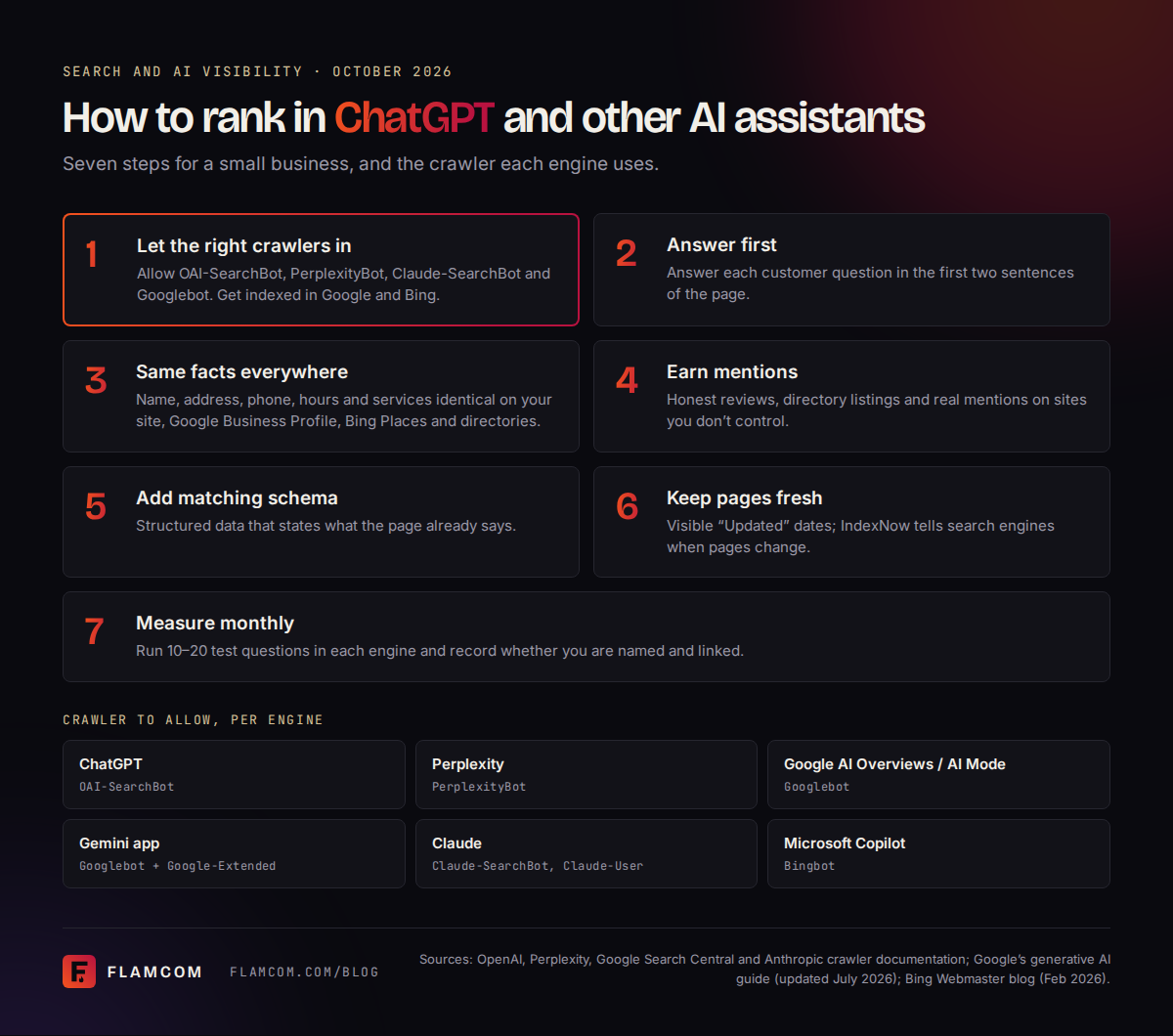
Work through these seven steps in order. The first three cost little and help every engine at once, and most owners can do them without hiring anyone.
1. Let the right crawlers in, and get indexed in Google and Bing
Open your robots.txt and confirm none of the search crawlers in the table above is disallowed, either by name or by a blanket rule under "User-agent: *". Then ask whoever runs your hosting or CDN (the network that serves your site's files) whether a bot-protection setting blocks AI crawlers, since a firewall can refuse a crawler that robots.txt allows.
Next, verify your site in Google Search Console and Bing Webmaster Tools, submit your sitemap in both, and fix pages reported as not indexed. Our view: if you only have an hour this week, spend it here, since Google's AI features quote only indexed pages and Copilot depends on Bing's index.
2. Write answer-first pages for the questions customers ask
List the 15 to 20 questions customers ask before they buy: price, area served, timing, what is included, how you compare. Each service page should answer its main question in the first two sentences, using the same words a customer would type or say.
Under each heading, answer one narrower question so the section still makes sense if an AI assistant quotes it alone. Replace adjectives with facts. "Fast, affordable service" gives an engine nothing to repeat. For example, a heat-pump installer might write "Same-week installs in Ada County, from $4,800 for a ducted system", which gives it a complete answer. Google says there is no need to chop pages into tiny pieces for AI.
3. Keep your business facts identical everywhere
Your business name, address, phone number, hours and services should read the same on your website, your Google Business Profile, Bing Places and the main directories in your trade. Google's guide says Business Profiles can help your products and services appear in AI responses and other Search results.
Write one master record and copy it everywhere. When your site says you open at 8 and a directory says 9, an AI assistant has two answers and no reason to trust either. On client work we call this master record a fact registry, and every listing is checked against it.
4. Earn mentions on sites you don't control
AI assistants lean on what other people say about you. Reviews, directory listings, a quote in local news and helpful answers in communities your customers use all add independent sources that agree with your website.
Earn these honestly. Ask every customer for a review after a job, and our automation service can send that request for you; our post on which workflows to automate first covers it. Join conversations only where you have something useful to add, under your real name. Google's guide says chasing inauthentic mentions across the web isn't as helpful as it might seem.
5. Add structured data (schema) that matches your page
Structured data, or schema, is code in your page that states facts such as your business type, services, prices and FAQs in a format machines read directly. Google's guide is plain that structured data isn't required for its generative AI features and that no special markup exists for them.
Our view: add it anyway, for the right reason. Schema keeps your facts stated one way in one place, and it supports regular search features. Every value in it must match the visible page. Treat it as housekeeping and skip anyone selling it as an AI shortcut.
6. Keep pages fresh and dated
Bing's February 2026 announcement advises regular updates so AI systems reference the current version of your content, and recommends IndexNow, a protocol that tells search engines when a page is added, changed or removed. Show a visible "Updated" date on pages where timing matters, such as prices, opening hours and seasonal services.
Freshness means real changes: edit the price when it moves, add new service areas, and refresh your top pages on a schedule.
7. Measure every month
Pick 10 to 20 test questions and run them in each engine monthly, recording whether you are named, linked and described correctly. Google's Search Console has a Generative AI performance report for its side, and Bing's AI Performance report covers Copilot citations. The FAQ below covers tracking visits in analytics.
How can you check your AI visibility in 20 minutes?
All you need is a browser and a notepad. Keep your notes to compare next month.
0 / 10
What doesn't work for ranking in ChatGPT?
Shortcuts sold as AI hacks mostly fail, and some carry legal risk.
An llms.txt file as a magic fix. Google's generative AI guide (updated July 2026) says you don't need new machine-readable or AI text files to appear in its features, and that Google Search doesn't use them. The crawler documents from OpenAI, Perplexity and Anthropic that we checked for this guide don't mention llms.txt.
Buying reviews. The US Federal Trade Commission's rule, announced August 14, 2024, bans buying or selling fake reviews, including AI-generated ones, and lets the FTC seek civil penalties against knowing violators.
One test, one verdict. Engines disagree with each other. Profound's July 2025 analysis of 100,000 prompts found only 11% of cited domains appeared in both ChatGPT and Perplexity. Ahrefs' study, updated June 2026, found Google's AI Mode and AI Overviews cited the same URLs only 13.7% of the time.
How does Flamcom track AI visibility for clients?
On our SEO retainer we test six AI engines each month and report each one on its own line: ChatGPT, Perplexity, Claude, Gemini, Google AI Overviews and Google AI Mode. The test uses 20 to 30 fixed questions agreed with you at kickoff, so month-to-month changes reflect your visibility.
The SEO retainer starts at $1,499 a month and is scoped after a free assessment; our SEO retainer page shows what a month of work includes. To compare that with freelancers and other agencies, see our guide to what SEO costs a small business.
Flamcom defines ranking in ChatGPT as being named or linked as a source in its answers, measured monthly across a fixed set of customer questions.
Flamcom's small business checklist for AI visibility starts with three steps: open the search crawlers, write answer-first pages, and match business facts everywhere.
Flamcom checks training crawlers such as GPTBot and ClaudeBot separately from search crawlers such as OAI-SearchBot and Claude-SearchBot when reviewing a client's robots.txt.
Questions about ranking in ChatGPT
How long does it take to show up in ChatGPT?
There is no fixed timeline. OpenAI says robots.txt changes reach its systems in about 24 hours, so unblocking OAI-SearchBot works quickly. Being cited still depends on your pages being worth quoting, and on other sites agreeing with them. Our view: answer-first pages can be picked up within weeks by engines that search live, while mentions built from reviews and directories grow over months.
Does ChatGPT use Google or Bing to find websites?
OpenAI says ChatGPT search uses its own crawler, OAI-SearchBot, and that it can also learn about URLs from a third-party search provider, which it does not name. Being indexed in both Google and Bing is still worth doing, because Google's AI features read Google's index and Microsoft Copilot reads Bing's. Verifying in Bing Webmaster Tools is free and quick.
Do I need an llms.txt file to get cited by ChatGPT?
No. Google's generative AI guide says its AI features do not need AI text files, and none of the crawler documentation from OpenAI, Perplexity or Anthropic that we reviewed asks for one. Crawler access, clear answers and matching business facts matter far more. Our free website checker tests whether AI crawlers can reach a page on your site.
Can a small local business get recommended by ChatGPT?
Yes. Local questions such as "electrician near me open Saturday" are where small businesses compete best, because the answer depends on local facts. A complete Google Business Profile and Bing Places listing, the same details on every directory, recent reviews and a service page per area give AI assistants a consistent picture to repeat.
Should I block GPTBot to protect my content?
That's your choice, and it is separate from search. OpenAI documents GPTBot as its training crawler and OAI-SearchBot as the one that surfaces sites in ChatGPT search, so you can block one and allow the other. Anthropic splits its agents the same way. Before changing anything, check your robots.txt and firewall settings, because a blanket rule can block both.
How do I know if ChatGPT is sending me customers?
Check three places. GA4's AI Assistant channel, added in May 2026, groups visits from sources such as ChatGPT, Gemini, Claude, Deepseek, Copilot and Grok, and ChatGPT adds utm_source=chatgpt.com to its links. Some visits arrive with no referrer and count as direct, so ask new customers how they found you. On our SEO retainer, the monthly report adds per-engine test results.
Is LLM SEO different from regular SEO?
LLM SEO, also called GEO, is the work of getting your business named and cited in answers written by AI assistants such as ChatGPT, Perplexity, Claude and Gemini. It builds on SEO: Google says optimizing for its AI features is still SEO, using the same index. Other assistants weigh outside mentions more, so per-engine testing matters. Our SEO vs AEO vs GEO comparison sets out the differences.
Find out whether AI assistants name your business today.
Ranking in ChatGPT comes down to open crawlers, answer-first pages, matching facts, honest mentions and monthly testing. You can start most of it yourself this week. If you'd like a second pair of eyes, a person on our team reviews your site and replies by email within one business day (Monday to Friday) with your free assessment.
If you send your website address, your free assessment includes:
- A mobile speed check, including Core Web Vitals (Google's speed and stability scores)
- Missing pages: the searches in your market that no page on your site answers yet
- Whether ChatGPT, Perplexity and Google's AI features name your business right now
Sources
- OpenAI: Overview of OpenAI crawlers, accessed 2026-10-02
- OpenAI Help Center: Publishers and developers FAQ, accessed 2026-10-02
- Perplexity: Perplexity crawlers, accessed 2026-10-02
- Google Search Central: Google's Guide to Optimizing for Generative AI Features on Google Search, accessed 2026-10-02
- Google Search Central: AI features and your website, accessed 2026-10-02
- Google Search Central: List of Google's common crawlers, accessed 2026-10-02
- Anthropic: Does Anthropic crawl data from the web, and how can site owners block the crawler?, accessed 2026-10-02
- Bing Webmaster Blog: Introducing AI Performance in Bing Webmaster Tools (Public Preview), accessed 2026-10-02
- Bing Webmaster Blog: Bingbot is coming to town, accessed 2026-10-02
- Google Analytics Help: What's new in Google Analytics (May 13, 2026), accessed 2026-10-02
- Google Analytics Help: Traffic-source dimensions, accessed 2026-10-02
- Federal Trade Commission: Federal Trade Commission announces final rule banning fake reviews and testimonials, accessed 2026-10-02
- Profound: Citation overlap strategy, accessed 2026-10-02
- Ahrefs: AI Overviews vs AI Mode, accessed 2026-10-02
More from the blog